
Emotional support letters work like identification for specific assistance animals. While you can still have your companion without an ESA letter, you will no longer be allowed certain privileges without it. For Baltimore residents, having an ESA can help you get your ideal apartment or dorm regardless of the pet policy.
This article is going to take an extended look at how to get an ESA letter in Baltimore, whether registration is necessary, when to renew an ESA letter, ESA laws in Baltimore, and more. By the end of this article, you will not only know about ESA laws, but you will also have a good idea of how to get an ESA, a psychiatric service dog, and what privileges they are granted by law.
Who Can Qualify for an ESA in Baltimore?
If you qualify for an ESA, you will need to have a qualifying disability. These include, but are not limited to, depression, anxiety, PTSD, bipolar disorder, certain phobias, ADHD, and more. These ailments must be diagnosed by a licensed mental health professional in Maryland, which can be provided to you through US Service Animals process of getting an ESA letter.
What Are the Benefits of Having an ESA Letter in Baltimore?
Having an emotional support animal in Baltimore can be a massive asset. Baltimore is one of the largest cities in the country, with a number of pet-friendly apartments, but having an ESA removes restrictions for places you may be partial to that restrict pets. With an ESA letter, you can live with your assistance animal anywhere, and you are not legally obligated to pay pet fees either.
Important Information About ESAs in Baltimore
Emotional support animals are not specifically covered by Baltimore or Maryland law, and federal laws like the Fair Housing Act are going to be the primary protection your animal will have. As far as individual pet laws, you will have to ensure that your ESA is a non-exotic animal within Baltimore, as most (but not all) are banned from ownership within city limits. Exceptions to this law include spiders, parrots, and frogs.
Facts About ESAs and Pets in Baltimore
Baltimore is a city that has become an important part of American history, with it largely being the inspiration for the Star-Spangled Banner, written by Francis Scott Key. There is a lot more to Baltimore than national anthems written a couple of hundred years ago, however. The following are some lesser-known facts surrounding Baltimore and its pets and emotional support animals.
- The American Pit Bull Terrier is the most popular breed in Baltimore.
- Baltimore is home to at least six dog parks: Canton, Latrobe, and Patterson.
- 39.1% of adults in Maryland experience anxiety or depression.
- Baltimore has several universities with living arrangements for students, like Johns Hopkins University, Loyola University Maryland, Towson University, and the University of Maryland, Baltimore County.
- Baltimore has 163 pet-friendly restaurants, including BMore Licks, Kooper’s Tavern, Pratt Street Ale House, and many, many more.
How to Get an Emotional Support (ESA) Letter in Baltimore
The first thing you will want to do is ensure that you have a qualifying disability, which can be diagnosed by a licensed mental health professional or LMHP. This can be done in person with a physician you have a pre-existing relationship with, or you can look for online options if you just want an ESA letter. Be wary when looking online, however, as many sites are scams and give fraudulent ESA letters.
Always look for sites that have been vetted through reviews and organizations like the Better Business Bureau to ensure you aren’t getting taken for a ride.
The steps to getting an ESA letter are as follows:
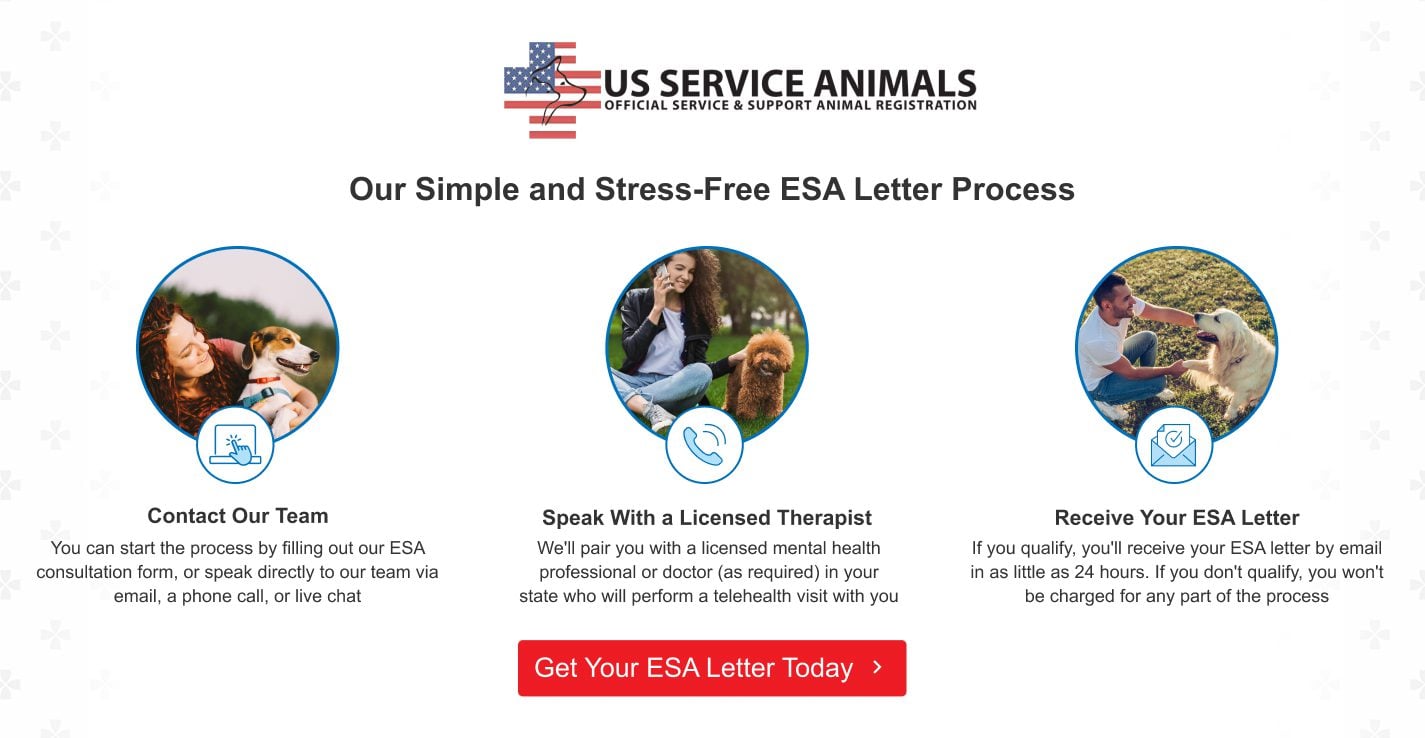
- Reach out to an LMHP for a consultation, both online and in-person. Alternatively, request a consultation through USSA to have our experts find an LMHP in Maryland for you.
- Talk with the mental health professional about your illness and how you feel an emotional support animal could improve your situation.
- If approved, the licensed mental health professional will write an ESA letter, which will be valid for one calendar year.
- Use the ESA letter to get around no-pet policies and landlords who are eager to charge monthly fees that your ESA is exempt from.
Bear in mind that not every mental health professional will see an ESA as an ideal fix for your condition. If you think you still may need an ESA, don’t be afraid to get a second opinion.
Do I Have to Get an ESA Letter in Baltimore from a Mental Health Professional in Maryland?
Yes, you need to get an ESA letter from a mental health professional who is licensed within the state of Maryland. This is very important, as fraudulent ESA letters can get you into legal trouble and also result in you being evicted. If you are concerned about your current LMHP or simply want the process handled for you, USSA always adheres to state and federal guidelines and can provide you with an in-state LMHP.
Emotional Support Animal Baltimore Regulations: What Are the Laws About ESAs in Baltimore?
If you own an emotional support animal in Baltimore, you will really only need to follow the city guidelines on what animals a person can have. Baltimore requires pet owners to get their cats and dogs vaccinated for rabies, and the pets must be licensed annually. Dogs must be taught not to bark endlessly, the call of nature should be cleaned by the owner, and animals must be given adequate care.
As for emotional support animal laws that can protect you in Baltimore, we will cover them and more below.
Airline and Travel ESA Laws in Baltimore: Can I Fly With an ESA in Baltimore?
Prior to 2021, emotional support animals were legally allowed to sit with their owners on long flights, so long as they could fit into the foot space. This is no longer true, and emotional support animals will more than likely have to be stowed with other pets unless the airline grants the request of the owner. Grounded travel is much the same, though many services offer pet-friendly policies that allow ESAs.
Can I Live Anywhere With an ESA in Baltimore?
Yes, your emotional support animal must be accommodated by a landlord unless they meet very specific exemptions that would cause harm to the landlord’s financial statement, property, or other tenants. This is due to the Fair Housing Act, which does not recognize emotional support animals as pets under housing, but as therapy tools for people with disabilities.
Because of an ESA’s distinction under the FHA, the landlord is legally prohibited from charging pet fees or rejecting ESAs because of policy.
Can I Bring My ESA to Work With Me in Baltimore?
If you want to bring your ESA to work with you, it will be up to your employer to determine whether or not an animal can seamlessly fit into your Baltimore workplace. While many businesses do allow the accompaniment of pets, others understandably cannot. There is no legal requirement for an employer to allow an employee to bring in an ESA, though many do make concessions when they can.
If you wish to bring your ESA to work, it may benefit you to show your ESA letter, along with an ESA registration or certification, should you have those documents. Explain how the emotional support animal can improve your output, and whether or not remote work is a possibility.
What Exceptions Are There to ESA Laws in Baltimore?
While there aren’t many exceptions to the Fair Housing Act, there are a few that owners of emotional support animals should be aware of. The first is that if your animal is uniquely large or exotic, it may be rejected if it cannot be reasonably accommodated. Similarly, if the animal causes property damage, threatens tenants, or is a massive financial strain on the landlord, it can also be rejected.
The final and perhaps strangest reason: if a landlord is living in one of the units and owns fewer than five units altogether, he can reject the emotional support animal.
Do I Need to Renew My ESA Letter Every Year in Baltimore?
Yes, you are going to need to renew or update your ESA letter every year, and failure to do so can result in evictions or potential fines if you continue to use it. ESA letters need to be renewed once a year in Maryland, and landlords will check to see if the letter is out of date. If you are forgetful, USSA offers automatic reminders to update your ESA letter as the expiry date draws near.
Do I Have to Register My ESA in Baltimore?
While it can be helpful to have an ESA registration, they are not required by law, and the only document you will need to verify your ESA is an emotional support letter written for Maryland. Many sites will hint at ESAs requiring registration, which is a massive, brightly colored red flag.
Registrations and ESA certifications can be helpful to add legitimacy to claims for landlords or employers. They can also put your assistance animal into the biggest ESA database in the nation, along with listing their relevant details. That said, it is always recommended to get an ESA letter before you try to get a certification or registration.
Public Access Baltimore ESA Laws: Where Can You Take Your ESA in Baltimore?

Within Baltimore, the only place your ESA is protected to go by law is inside your home. Past that, you will need to rely on public areas within the city that are pet-friendly, or businesses that allow dogs, cats, and other ESA animals. Many people tend to choose more common animals for ESAs, as they allow them more public access when they decide to go out.
A dog in a store isn’t that big of a deal; a miniature horse may raise some questions.
Here are some of the pet-friendly places you can go to in Baltimore:
-
- Restaurants include Mama’s on the Half Shell, Alexander’s Tavern Fells Point, Verde, Blue Pit BBQ & Whiskey Bar, Loch Bar, The Point in Fells, DogWatch Tavern, Max’s Taphouse, Philip’s Seafood, and more.
- Dog Parks include Federal Hill Park, Locust Point Dog Park at Latrobe Park, Howard’s Dog Park, Patterson Dog Park, Canton Dog Park, and Paw Point Dog Park.
- Pet Stores & Services include Spas for Paws, The Puptrait Studio, East Coast Academy of Dog Training Inc., Spirit Path Acupuncture, PETCO, and more.
Baltimore is a huge city. Thankfully, there are hundreds of pet-friendly places to choose from. If you want a canine that can cruise through most parts of public life, psychiatric service dogs are a good choice.
How to Get a Psychiatric Service Dog in Baltimore?
A psychiatric service dog or PSD is a trained canine that is taught to perform specific tasks based on the disability of its owner. They are allowed to go in most public places, and the mental illnesses that qualify for an ESA also qualify for a PSD. They can be more pricey to get, as training can be expensive, though USSA offers an affordable program to get a dog certified as a psychiatric service dog.
To get a psychiatric service dog, you will need to:
- Have a qualifying disability.
- Reach out to a licensed mental health professional for a consultation.
- Have them write you a letter of need for a psychiatric service dog.
After that, you can choose from the variety of options available, whether that be purchasing one directly, having one trained, or hiring a trainer. If you think you could benefit from a psychiatric service dog, fill out our PSD consultation form to get started.
How to Get an ESA Letter in Other Cities in Maryland
Get an Emotional Support Animal (ESA) Letter in Baltimore Today
When it comes to people that emotional support animals can benefit, the assistance animal casts a wide net. Their companionship can help improve the moods of people with depression, calm the racing minds of those with anxiety, and lessen loneliness for those suffering from social anxiety. If you want to improve your outlook and everyday existence, schedule your risk-free consultation today.