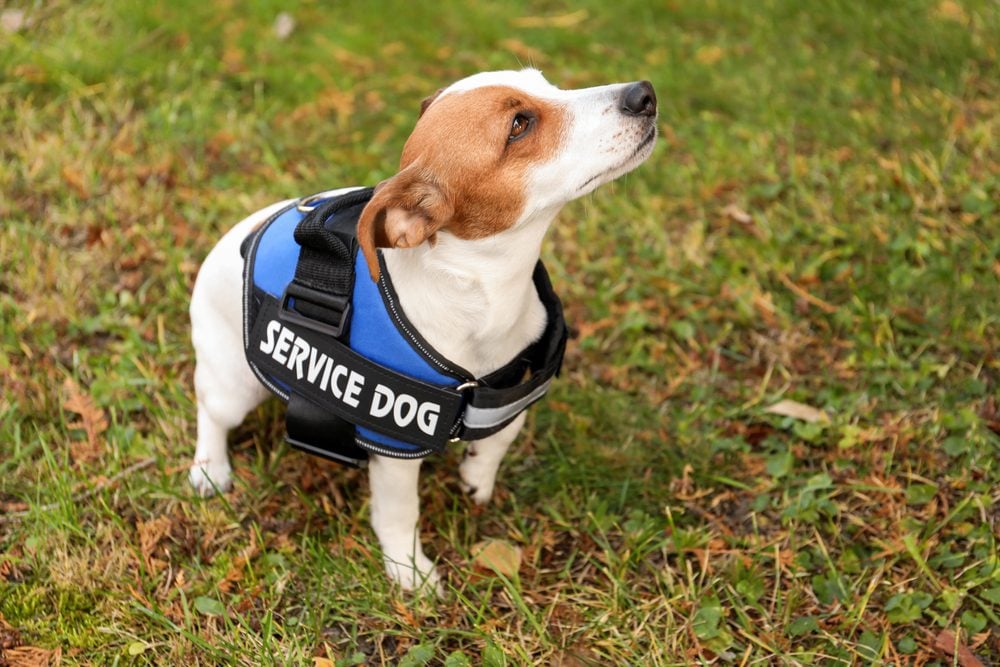
Service dogs are given public access rights by the federal government. Under the Americans with Disabilities Act (ADA), service dogs enjoy the benefit of accompanying their handler in public spaces. Therefore, a service dog can legally enter any place the handler is allowed, even if there’s a no-pet policy in place.
However, numerous businesses have no-pet policies, leading many service dog handlers choosing to put a specialized service dog vest on their assistance animals. A service dog vest makes it obvious that the dog is there to assist an individual with a disability, and it can potentially prevent conflict and unwanted public interactions.
As life-saving as service dog vests are, many people pretend to have a service dog by making their dogs wear these vests despite not having any disabilities. Fortunately, our article is here to explain how you can spot the differences between a real service dog vest and a fake service dog vest.
What Is a Service Dog?
Legally speaking, a service dog is a dog that is trained to assist an individual with a disability. Unlike pet dogs, these dogs are highly trained animals that help their handler in various ways. Some of the common service dog tasks include retrieving items from the ground, reminding them that it is time to take medication, and providing balance support.
Given these tasks make them more of a medical necessity, the Americans with Disabilities Act grants them public access rights. They can accompany their handler in places that are otherwise not pet-friendly, like restaurants and government buildings.
Unless the service dog is out of control, destructive, or causes a health and safety risk with their presence, they can’t be removed from a space or denied access. However, there are also certain limits to this. For example, a service animal can enter the indoor area of a restaurant but cannot enter the kitchen. The same goes for hospitals – a service animal can enter the waiting area but not areas where sterile medical checks and services are conducted.
Service Dog vs. Emotional Support Dog
Service dogs and emotional support dogs are commonly mistaken for each other. Before we get to covering real service dog vests vs fake ones, note that service dogs and emotional support dogs aren’t the same.
Service dogs are dogs trained to perform tasks to assist their handlers, whereas emotional support animals don’t have any training requirements. These dogs are recommended by a licensed mental health professional and prescribed with an ESA letter to provide therapeutic benefits to an individual with a mental health disability or condition. Emotional support dogs don’t have the same public access rights as service dogs, though they have housing rights protected under the Fair Housing Act.
Is a Service Dog Vest a Requirement?
Service dogs aren’t required to wear a vest that indicates that they are service dogs. The handlers can simply put a standard dog harness on their service dogs and go about their days.
However, as mentioned above, many service dog handlers choose to get a vest to avoid people asking them to leave because they have a dog. Most businesses in the US know the federal law on service dogs and simply don’t bother to question it if a customer walks in with a dog wearing a service dog vest.
Additionally, many dogs are trained to be in “work mode” when they have their service dog vests on. It is remarkable to watch how intensely a dog switches from being a playful pup to a serious assistant ready to do whatever their handler needs once their vest is put on.
Knowing this, many people without service dogs take advantage of service dog vests and pretend that they have a service dog. This not only creates a problem for business owners but also for people with real service dogs, as it diminishes the credibility of these wonderful assistance animals. Fortunately, some signs can help you determine whether a service dog is real or not.
Real Service Dog Vest vs Fake Service Dog Vest
Since service dog vests are just like any other dog vest, there isn’t a reliable way to tell whether one is real or fake. Sure, you can look at the build material and the fit on the dog to get an idea of it, but it won’t go any further than a guess. There isn’t a real or fake service dog vest – any vest that says service dog or service animal on it is acceptable. However, the behavior of the animal wearing the service dog vest can give you a better idea of whether the dog is a fake service animal or not.
Real Service Dog Vest vs Fake: Asking the Right Question
Service dog vests are completely optional, and there is no such thing as a real or fake service dog vest. While many dogs are trained to be in working mode when wearing a vest, countless service dog handlers simply opt for something more comfortable than a service dog vest for their assistance animals, such as a marked leash.
The question you should be asking here shouldn’t be about the vest but what the dog wearing it is doing. You can’t tell whether a service dog is real or not simply by looking at the vest; you will need to observe behavior and the overall appearance of the dog to spot a fake service dog.
How to Spot a Fake Service Dog?
There are quite a few ways to tell if a service dog is real or fake. First and foremost, observe the dog’s behavior. Service dogs don’t just receive training for tasks to assist their handler. They also undergo strict obedience training to ensure they don’t mind distractions and stay focused on their job. Naturally, these dogs are very focused on and attentive to their handlers.
If the service dog you suspect to be fake acts aggressively, pulls on their leash, tries to sniff people or other animals, reacts to things happening around them, and displays an overly social demeanor, it is safe to suspect something is off. These are particularly a red flag in settings where it is common to see service dogs, such as within grocery stores, restaurants, and airports.
Additionally, the type of service dog and the dog’s breed must match. For instance, if you see a toy poodle as a supposed mobility assistance dog, that’s a red flag. This breed doesn’t have the physical capability to assist someone with a disability, though toy poodles make excellent psychiatric service dogs.
What to Do After Spotting a Fake Service Dog
If you suspect a fake service dog, there isn’t a lot you can do about it. The federal law only allows asking two questions to service dog handlers, which are:
- Is the dog a service animal required because of a disability?
- What work or task has the dog been trained to perform?
Besides these two questions, business owners or store managers cannot inquire more about the service dog. Requiring the dog to perform a task or asking for proof of training is not lawful. Therefore, you shouldn’t confront the owner even if you know that the dog is a fake service dog.
However, you can ask the handler to remove the service dog if the dog misbehaves and the handler cannot get the dog under control. Note that in these cases, the handler can still benefit from the services of the business, but without the service dog’s presence. Businesses simply cannot deny services because the handler has a “service dog” that can’t be under control.
Also, you can report a suspected fake service dog. Document the incident in detail and report it to law enforcement by calling the non-emergency phone line.
What Service Dog Handlers Should Know
If you’re a service dog handler and are worried that business owners might think that the vest your service dog wears is fake, you shouldn’t have much to worry about. As previously mentioned, there’s no such thing as a real or fake service dog vest. A service dog vest is simply a service dog vest.
What matters is how your service dog behaves. If you notice any undesirable behaviors, such as excitement in particular places or easily getting distracted in the presence of other animals, practice training to eliminate these unwanted behaviors. Follow a reward-based approach to teach your service dog that certain behaviors are unacceptable in public. Consult a professional dog trainer for further advice on keeping your service dog under control and properly trained in public.