Many people can’t imagine life without their pets because of the comfort and joy they bring, but for some, animals play an important part in managing emotional or psychological disabilities. Losing access to this support can increase anxiety, deepen depression, disturb sleep, or affect everyday functioning.
Fortunately, federal housing protections recognize the importance of emotional support animals (ESAs) as part of a person’s treatment plan and provide legal pathways to keep your companion animal with you, even if a building doesn’t allow pets.
However, this is only possible if you obtain a written ESA recommendation from a mental health professional that confirms your disability and the role your animal plays in treatment.
This guide explains how to get an emotional support animal (ESA) letter in Charleston, SC, and how to make sure that it’s genuine.
Who Can Qualify for an ESA in Charleston?
ESA eligibility isn’t limited to severe psychiatric disorders. You may qualify if you have a mental or emotional health condition that makes daily life more challenging than usual.
This includes common issues like anxiety, depression, chronic stress, PTSD, panic attacks, or even feeling emotionally overwhelmed during life transitions. Conditions like ADHD, social anxiety, trauma-related symptoms, and mood disorders also fall under the umbrella of qualifying disabilities.
Keep in mind that you won’t qualify based on self-diagnosis. You need to attend a clinical assessment with a mental health expert who has a license to practice in your state, so they can officially diagnose you and confirm that you’d benefit from having an ESA at home.
If you don’t already have a therapist, US Service Animals (USSA) can connect you with a licensed provider in South Carolina.
What Are the Benefits of Having an ESA Letter in Charleston?
Having a legitimate ESA letter provides important legal advantages in a city where pet owners face tight housing restrictions due to historic buildings, a competitive rental market, and densely populated neighborhoods.
When a mental health provider includes an emotional support animal in your treatment plan, you gain protections under federal law. Landlords have to set aside their standard pet rules and allow your ESA, no matter the breed or size, and they’re also required to remove all pet-related fees from your lease.
In other words, you gain the freedom to live with your animal without discrimination or extra charges.
Important Information About ESAs in Charleston
Many of the city’s most charming apartments sit inside historic homes downtown. They’re appealing, but they’re also known for strict no-pet rules. Even newer complexes in areas like Daniel Island, Mount Pleasant, or James Island often have long lists of banned breeds and tight size limits that block many pet owners.
This is exactly why having an ESA letter matters so much in Charleston. When you submit your letter alongside your housing application, landlords have no option but to waive all pet/breed restrictions and additional charges.
In short, if your ESA is a pit bull, a large mixed breed, or any other type commonly banned by Charleston landlords, you’re still legally entitled to housing under the Fair Housing Act (FHA).
Colleges and universities in the city also prohibit animals in student housing. However, if you have an ESA letter for a qualifying disability, the institution has to make an exception.
Facts About ESAs and Pets in Charleston
Here are some facts about Charleston:
- Approximately 20% of South Carolina adults experience mental health challenges each year.
- Charleston County is home to tens of thousands of registered dogs and cats.
- The College of Charleston, MUSC, The Citadel, and Charleston Southern University all have dorms with strict no-pet rules unless ESA accommodations are approved.
- The Charleston area has 8+ dog parks, including James Island County Park’s renowned dog beach.
- Annual celebrations such as Yappy Hour at James Island County Park draw hundreds of dog lovers throughout the year.
How to Get an Emotional Support (ESA) Letter in Charleston
The process involves getting a clinical evaluation, confirmation of a qualifying mental or emotional disability, and documentation that your animal plays a therapeutic role in managing your symptoms.
Unfortunately, many people in Charleston have to deal with fraudulent ESA websites, uncertified providers operating in the wrong state, or long wait times to see a qualified mental health professional.
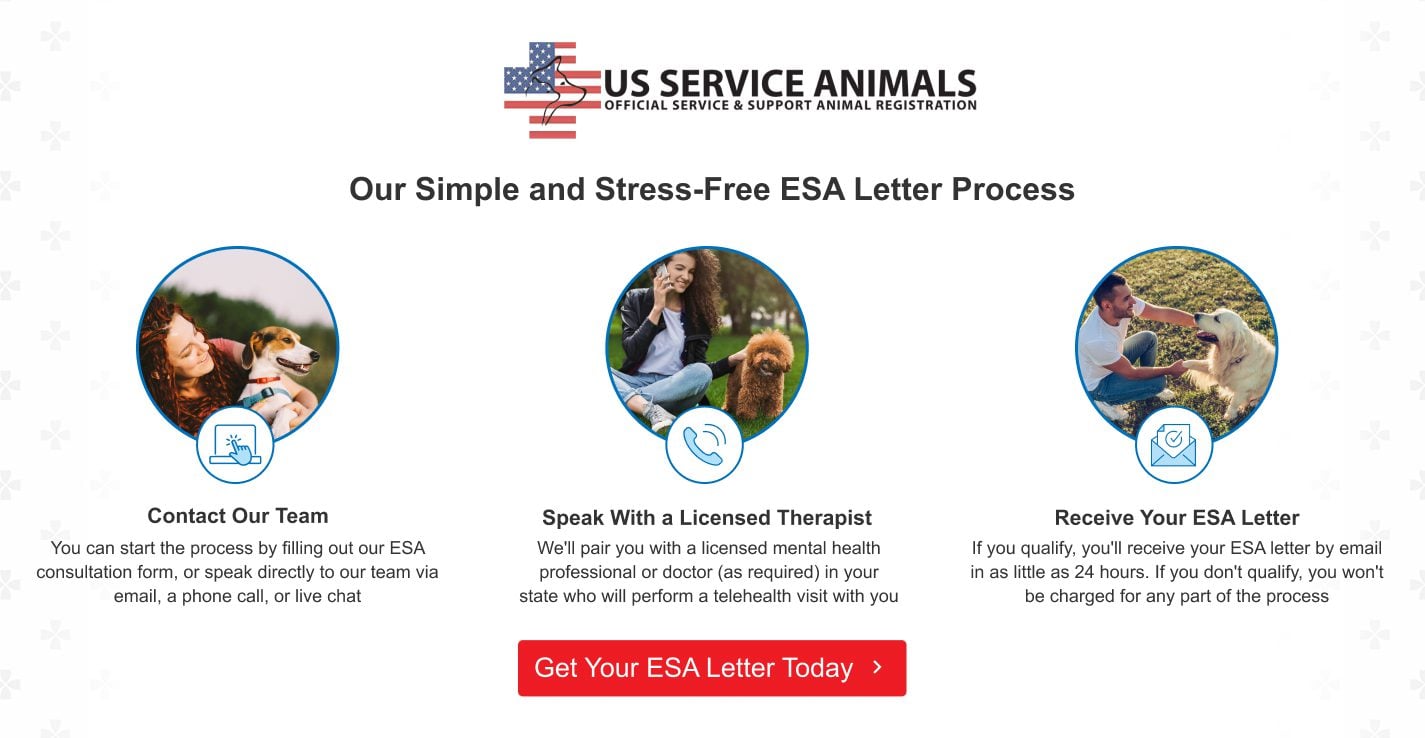
US Service Animals helps eliminate these challenges by connecting you with a South Carolina-licensed clinician who can issue your ESA letter within 24 hours, if needed. Rest assured that it’ll be compliant with federal standards.
Below is our step-by-step process:
- Submit a short contact form or call us at (985) 570-5388, so we can match you with the right mental health expert.
- You’ll meet with the professional online to discuss your symptoms, challenges, and how an ESA may help improve your daily functioning.
- If the clinician decides that an ESA is appropriate, you’ll receive a letter that includes all legally required details (license number, signature, confirmation of need, and animal information).
Do I Have to Get an ESA Letter in Charleston from a Mental Health Professional In South Carolina?
Your ESA letter will only be valid if a mental health provider with an active South Carolina license evaluates you. Even if you’re moving to Charleston or plan to use your ESA letter in another city later, the provider must be licensed in the state where you currently live.
This rule is meant to protect you. It confirms that a real therapeutic relationship exists and that your provider is legally allowed to diagnose your condition and recommend an ESA as part of your treatment.
If you don’t have a qualified therapist, US Service Animals can connect you with one. Our process follows state and federal guidelines, so your ESA letter will be recognized by Charleston landlords.
Emotional Support Animal Charleston Regulations: What Are the Laws About ESAs in Charleston?
Since ESA laws in South Carolina don’t provide any protections beyond the FHA, your ESA letter has to meet all federal requirements.
First, it has to be written by a licensed mental health professional in South Carolina who has evaluated you and confirmed that you meet the criteria for a mental or emotional disability. The letter they provide should explain that your ESA is an important part of your treatment plan without listing your exact diagnosis.
Secondly, it needs to be written on the professional’s official letterhead and include the provider’s full name, contact information, licensing information, and signature.
Airline and Travel ESA Laws in Charleston: Can I Fly With an ESA in Charleston?
Ever since the Air Carrier Access Act (ACAA) was updated, most airlines now classify ESAs as pets and require owners to adhere to standard pet policies. This generally includes paying pet fees and placing the animal in an approved carrier that meets size limits for in-cabin travel.
While some on-ground transportation providers may voluntarily allow pets, your ESA isn’t guaranteed a spot on rideshares, buses, ferries, or in taxis in Charleston. If reliable public access is important to you or you travel frequently, you may want to explore whether you qualify for a psychiatric service dog (PSD) instead. These dogs are treated differently under federal law. You’ll find more details in the PSD section later in this guide.
Can I Live Anywhere With an ESA in Charleston?
As long as you have a valid ESA letter, you’re free to live in any downtown or Mount Pleasant apartment, a rental home in West Ashley or James Island, a modern development in North Charleston, or a condominium complex anywhere in the city.
College housing is also covered under the FHA. Dorms and campus residences at the College of Charleston, The Citadel, Charleston Southern University, and MUSC have a legal obligation to provide equal access to housing for students with qualifying disabilities so they can keep the animal that supports their emotional well-being.
Can I Bring My ESA to Work With Me in Charleston?
Bringing your support animal to work sounds great, but unfortunately, ESAs aren’t protected by the Americans with Disabilities Act (ADA). Workplaces can decide their own policies, and many choose to restrict animals due to safety, allergy, or liability concerns.
That said, you can still talk to your employer and request reasonable accommodation if your ESA helps reduce anxiety or manage symptoms that affect your job performance.
Some workplaces in Charleston, particularly smaller offices or pet-friendly companies, may be open to allowing your ESA after reviewing your case. However, keep in mind that the decision is ultimately up to your employer.
What Exceptions Are There to ESA Laws in Charleston?
The law protects ESAs as much as it protects the safety and well-being of everyone in the building. If your ESA is dangerous, disruptive, or destructive, the landlord can legally refuse the accommodation.
FHA protections don’t apply to specific types of housing, such as owner-occupied buildings with four or fewer units, or single-family homes rented without a real estate agent and where the owner owns no more than three properties.
Do I Need to Renew My ESA Letter Every Year in Charleston?
Yes, annual renewal of your ESA letter is needed to confirm that your mental or emotional health condition is still present and that your ESA continues to play an important role in your treatment.
Charleston landlords, property managers, and university housing offices may check whether your document is up to date before approving accommodations. Our team at US Service Animals will send a reminder when it’s time to renew, so you don’t have to keep track yourself.
Do I Have to Register My ESA in Charleston?
You don’t have to register your ESA anywhere to make it official. Anyone who tells you that registration is required for legal status should be treated as a potential scam.
That said, landlords sometimes feel more at ease when you can provide additional documentation like your animal’s ID card or an ESA certification. These things can help avoid awkward conversations with neighbors or property staff, especially when living in tight-knit neighborhoods.
We make it easy to get additional paperwork. Just fill out our ESA registration form, and our team will guide you through submitting your basic details and information about your support companion to get the documents you need.
Public Access Charleston ESA Laws: Where Can You Take Your ESA in Charleston?

Public access rights for ESAs apply exclusively to housing. Businesses and public facilities in Charleston are free to choose whether or not to allow ESAs. Unless a location has a pet-friendly policy, restaurants, retail stores, hotels, public transportation, and tourist attractions don’t have to accommodate your ESA.
Fortunately, many establishments voluntarily welcome well-behaved animals. Popular outdoor dining spots, such as Poogan’s Porch, Fuel Charleston, Lowdown Oven & Bar, and The Park Cafe, permit dogs on their patios.
Public parks, including Hampton Park, James Island County Park, Cannon Park, and the dog park at Bees Landing Recreation Area, have open spaces for your canine companions. Several local boutiques and coastal shops, especially around King Street and Folly Beach, also maintain pet-welcoming policies.
If you need an animal to accompany you into places that don’t allow pets, a psychiatric service dog may be a more appropriate option.
How to Get a Psychiatric Service Dog in Charleston?
A psychiatric service dog provides greater access rights than an ESA, which makes them an excellent option for Charleston residents who need their animal to help manage their symptoms in public spaces, workplaces, and during air travel.
The process of obtaining a PSD begins with confirming that you meet the diagnostic criteria for a psychiatric disability, such as anxiety, PTSD, depression, or panic disorder. If you qualify for an ESA, you already meet the baseline requirements for PSD eligibility.
You can also keep both if you like. For example, if you have a dog trained as a PSD but also rely on a cat, rabbit, or other pet for emotional comfort, that second animal can remain an ESA.
To find out if you qualify, fill out our PSD consultation form and consult with a licensed mental health professional. The next step is to enroll in an online PSD training course so that your dog can learn how to assist you during anxiety episodes, interrupt harmful behaviors, or provide grounding pressure.
How to Get an ESA Letter in Other Cities in South Carolina
Get an Emotional Support Animal (ESA) Letter in Charleston Today

Managing emotional or psychological symptoms can feel isolating in a busy city like Charleston. For many people, their pets play a therapeutic role in helping them perform daily functions. This is why ESAs are recognized under federal housing law as a legitimate part of your treatment plan.
With an ESA letter, you can keep that support close, even in housing situations that prohibit pets. Schedule your risk-free consultation with US Service Animals to start the process.