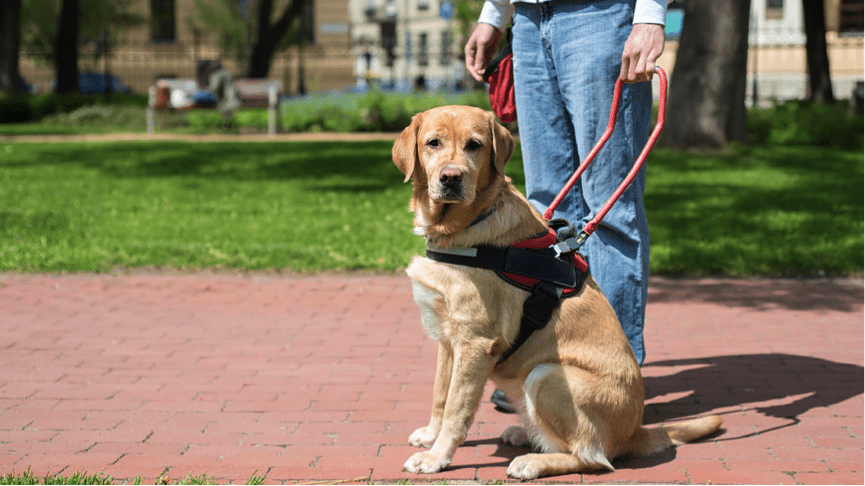

Service dogs are essential for many people who suffer from long-term health conditions. They help provide assistance, care, and support to their owners. From diabetes and autism to multiple sclerosis and fibromyalgia, there are numerous conditions that can allow someone to receive the support of a service dog.
Service dogs are classed as working dogs and can be with their owner in many situations and environments. However, like everything, some laws need to be followed. This is for the safety of the service dog, their owner, and the public. Our guide will give you an overview of the service dog laws applicable in the state of Virginia, so you know what your rights are when accessing spaces with your service animal.
Virginia’s Disability Rights Law
The Code of Virginia, section 51.5-44, outlines the rights of individuals with disabilities in regard to accessing public and private spaces with their service dogs. These laws uphold the federal access protections granted by the Americans with Disabilities Act (ADA), and they give further definitions and regulations for how service dogs should be identified and the specific rights of individuals accessing spaces with their service dogs in Virginia.
In Virginia and within the ADA, service animals are defined as dogs that have been trained to complete tasks that directly benefit and support an individual with a disability. For example, a service dog may be trained to provide medical alerts for someone with blood sugar issues, or they may guide someone who is visually impaired. A service dog must be trained to complete these disability-related tasks, or they are not eligible to be protected by Virginia state laws and the ADA as a valid service animal.
Additionally, under the Virginia Code and the ADA, individuals who require the assistance of a service dog must be granted access to public and private spaces such as retail stores, private businesses, motels and hotels, restaurants, malls, schools, and workplaces.
The only potential exceptions to access rights for service dogs include specific religious organizations where an owner might need to request permission to enter with a dog and spaces where the presence of a service dog might present a significant threat or issue, such as within an operating room.
Do Virginia Laws Cover Emotional Support Animals?
Virginia’s disability access laws do not include protections for emotional support animals. These are animals that provide emotional support, comfort, and well-being to their owners, something that is highly valuable but does not qualify them as working animals.
Even if comfort and support are part of the benefits that someone with a service dog receives, this cannot be the only reason for a service dog’s adoption; a service dog in Virginia must provide physical support or complete disability-related tasks for their owner when accompanying their owner into any public or private space.
Can My Service Dog Be Denied Access to a Public Space In Virginia?
Service dogs can be told to leave a public or private place if they are acting as a potential threat to others, such as behaving aggressively or in an out-of-control manner. However, service dogs go through extensive training and will rarely act like this; if you do see a supposed service dog acting badly, they may not be properly trained, or they may not be a valid service dog.
What Should My Virginia Service Dog Wear?
Virginia Code states that all service dogs must have a backpack, harness, or vest that identifies them as trained service dogs. If a service dog is in training, the vest or identifying equipment must make this known.
Handlers who wish to train their service dogs in public or private spaces must also adhere to these laws stating that identifying equipment for service dogs must be worn when the animals are in public and private spaces.
Can Private and Public Spaces in Virginia Ask for Service Animal Proof?
Under both the Virginia Code and the ADA, businesses, private spaces, and public spaces are not legally allowed to ask the owner of a service dog about the specifics of their disability, nor are they allowed to demand proof, identification cards, or demonstrations of a dog’s service skills.
Additionally, the Virginia Code states that public and private spaces are not legally allowed to charge the owner of a service dog for access to their business in order to have their service dog admitted alongside them. The only charges that a private or public space may request from a service dog owner are when the service dog has actively caused damage or destruction on the property.
Does My Service Dog Have Housing Protection in Virginia?
Both the federal Fair Housing Act (FHA) and Virginia Code prohibit anyone from discriminating against someone for having a service animal in their home. Landlords should always allow full and equal access to all housing types and should not charge extra for having a service dog on the premises. When a lease or rental unit has a ‘no pets’ policy, this does not apply to a service animal.
Owners living with their service animals are not subject to any breed restrictions or pet restrictions, and they are not legally allowed to be charged any additional pet rent, pet fees, or pet security deposits. However, this does not apply to instances of damage or destruction where their service dog has caused significant financial damage to the landlord’s property; owners will typically be required to pay for these damages.
Service Dogs in Virginia: Know Your Rights
When it comes to living alongside your service dog in Virginia, it’s essential that you understand your rights, especially when it comes to accessing public and private spaces. Fortunately, the Virginia Code backs up many of the access protections put in place by the ADA, allowing you to enter private and public spaces with your service dog, in addition to living alongside them, without discrimination.