

Emotional support animals can be life-changing for Delaware residents managing anxiety, depression, or other mental health conditions. Knowing ESA Delaware laws is crucial to make sure your companion animal is legally recognized and your rights are protected.
Delaware’s mix of urban and coastal living means each city has different rental markets and pet-friendly options. Whether you’re in Newark, Dover, or the beach towns, understanding ESA requirements helps you navigate housing rules confidently.
This article walks you through ESA Delaware requirements, how to get a valid ESA letter, and what rights you have across the state’s cities. It’s designed to help you make informed decisions for your home and lifestyle with your emotional support animal.
Delaware ESA Laws: Summary of Legal Protections
Delaware emotional support animal laws follow the federal guidelines under the Fair Housing Act (FHA). The state doesn’t have a separate state statute defining ESAs or expanding their rights beyond what federal law provides.
However, Delaware recognizes ESA letters issued by licensed mental health professionals (LMHPs) and enforces anti-discrimination rules in housing and limited employment contexts under federal standards.
Emotional Support Animal Delaware Regulations: ESA Laws in Delaware
Delaware does not have an independent ESA statute, but it does enforce related laws affecting accommodation and misrepresentation. Below is a detailed breakdown of your and your ESAs’ rights.
Delaware ESA Housing Laws
Under the Fair Housing Act (FHA), as well as Delaware Fair Housing Law Del. Code tit. 16, § 4603A(a)(2), Delaware landlords must make reasonable accommodations for tenants or applicants with disabilities and verified emotional support animals, even in buildings with no-pet policies.
Landlords are prohibited from charging extra pet-related fees or deposits when presented with a valid ESA letter confirming the animal’s therapeutic necessity. However, they may deny requests only if an animal poses a safety risk, causes significant damage, or would create an undue burden.
Delaware ESA Employment Laws
While employers are required to make reasonable accommodations for their employees, that does not mean that you are legally guaranteed the right to bring your ESA to work with you, since they are not considered service animals.
Nonetheless, some workplaces may be willing to allow your ESA to accompany you to work each day, even though it’s not a legal right – especially if you have a legally valid ESA letter. It’s always worthwhile to ask, in case they are willing to accommodate you.
While it can be scary to talk to your boss about the importance of an emotional support animal, many are far more understanding than one may think. In fact, many welcome well-behaved companions in the office to make the work environment more enjoyable.
Delaware ESA Travel Laws
When traveling on public transportation within Delaware (such as DART buses, Amtrak, or ferries), only service animals are automatically accommodated under the Americans with Disabilities Act (ADA).
Emotional support animals do not qualify for ADA access and can be refused boarding or required to comply with pet carrier and fee policies. Transportation companies, hotels, and other public places are allowed to decide individually whether to accept ESAs, though many do so voluntarily if advance notice is given.
Delaware ESA Travel and Flying Laws
The U.S. Department of Transportation (DOT) revised the Air Carrier Access Act (ACAA) in 2020-21, removing automatic flight privileges for emotional support animals. Airlines may now treat ESAs strictly as pets, enforcing their own pet policies on size, fees, and cabin carriers.
Currently, all major U.S. airlines serving Delaware, including American, Delta, United, and Southwest, require that ESA owners pay standard pet fees and comply with pet‑in‑cabin weight and carrier restrictions. Some also require you to submit pet health documents and opt to transport large pets as cargo.
How to Get an ESA Letter in Delaware: ESA Letter Delaware Requirements
To have your emotional support animal legally recognized in Delaware, you need a valid ESA letter from a licensed mental health professional (LMHP). This could be a psychologist, psychiatrist, or licensed therapist who can evaluate your condition and confirm that an emotional support animal is part of your treatment plan.
Once you have your letter, you can present it to landlords or property managers when requesting housing accommodations. Under federal law, which Delaware follows, landlords must make reasonable accommodations for tenants with a valid ESA letter, even if the property normally has a “no pets” policy.
That said, please note that all legitimate ESA Delaware letters must include the provider’s credentials, license number, and a statement verifying your need for the animal. It’s also crucial to understand that an ESA letter in Delaware gives you housing protections, but doesn’t grant public access rights like a service animal.
For more guidance on obtaining a legitimate ESA letter, including tips on working with licensed professionals and ensuring your documentation meets legal requirements, check out our dedicated resource on how to get an ESA letter.
Do You Need an ESA Letter in Delaware?
Yes. Without an ESA letter in Delaware, your support animal will be considered a regular pet. This means you won’t be able to utilize the rights provided under the Fair Housing Act. If you don’t have an ESA letter, Delaware landlords can deny your request to live with your pet. Even if they allow, you might be subject to pet fees, rent, and other recurring expenses.
The only way to avoid all of these is a legitimate ESA letter provided by a certified professional with a license to practice in Delaware.
Who Can Write an ESA Letter in Delaware?
A legitimate ESA letter in Delaware must come from a licensed mental health professional (LMHP). This includes psychologists, psychiatrists, licensed clinical social workers, or other mental health providers recognized under Delaware law. The critical nuance is that the professional must be authorized to practice in the state.
Delaware does not impose a specific minimum duration of your relationship with the provider before they can issue an ESA letter, nor does it require the letter to be written by a medical doctor (MD). What matters most is that the professional is licensed in Delaware and can attest that the emotional support animal mitigates symptoms of your condition.
ESA Delaware Registration: ESA Certification in Delaware
You don’t have a legal requirement to register or certify your emotional support animal in Delaware (or anywhere in the United States). Your housing rights are established solely through a valid ESA letter from a licensed mental health professional.
Any registration or certification program is entirely optional and cannot replace your ESA letter or provide additional legal protections beyond what federal and state laws already grant.
That said, some Delaware residents choose to pursue ESA certification as an add-on document. It serves as additional proof that your ESA letter is legitimate and that you have worked with a licensed professional to obtain it. This can help prevent confusion or disputes with housing providers, especially in competitive rental markets like Wilmington, Newark, or Rehoboth Beach.
Get an ESA Letter in Cities Across Delaware
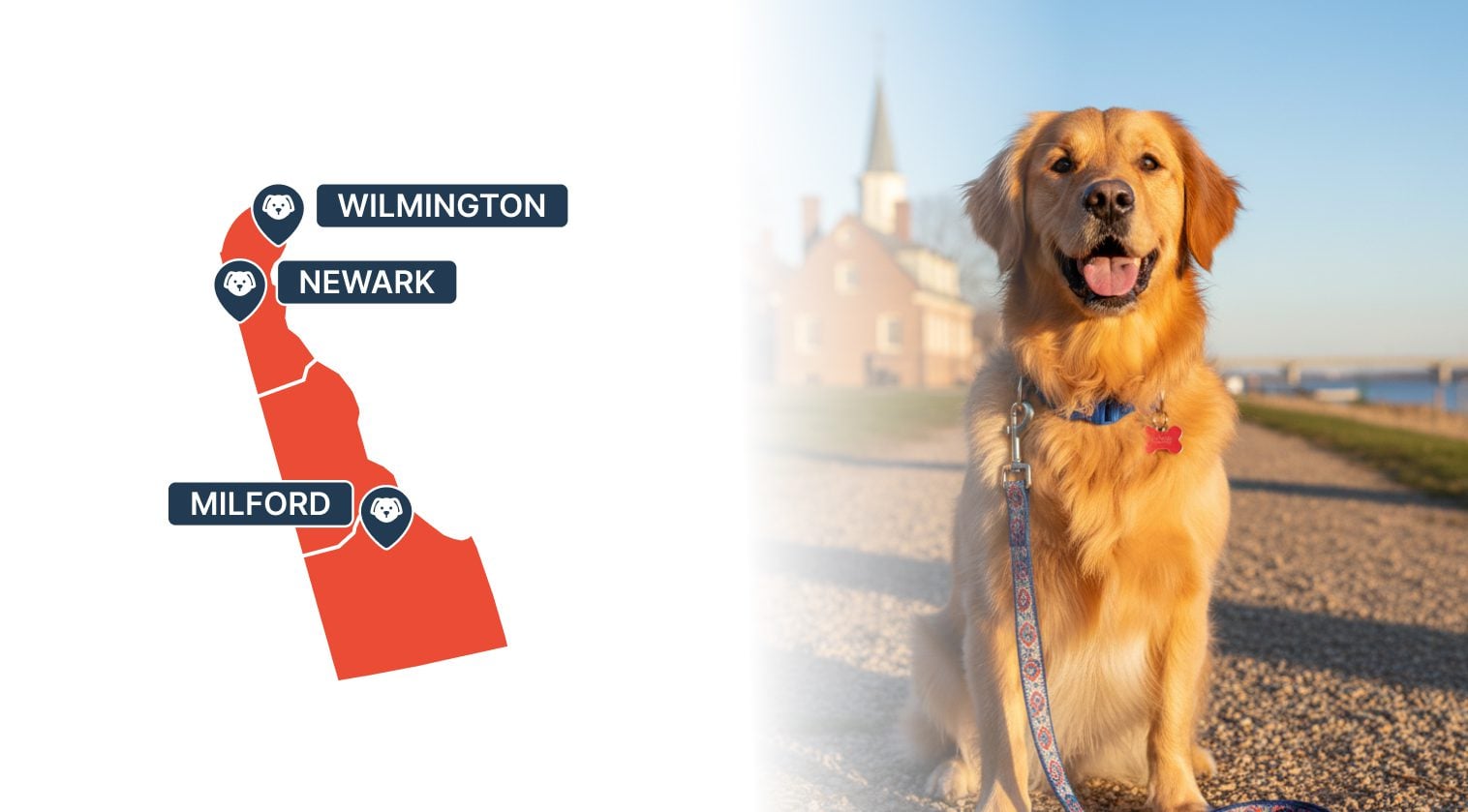
Below, we provide an overview of ESA laws in the most popular cities in Delaware; to find out more, including how to get a legally valid ESA letter in these cities, click on the linked heading for the city you’re curious about.
ESA Laws in Wilmington
As Delaware’s largest city, Wilmington follows federal ESA regulations while offering a pet-friendly environment. To secure a valid ESA letter in Wilmington, residents must consult a Delaware-licensed mental health professional, such as a psychologist, psychiatrist, or licensed therapist.
Wilmington’s Riverfront and Brandywine Park provide ample outdoor spaces for ESAs, and many cafés and restaurants offer outdoor seating. Landlords must honor Fair Housing Act requests for documented ESAs, even if the property normally prohibits pets. Remember, ESAs do not have public access rights like service animals.
ESA Laws in Dover
Dover, Delaware’s capital city, follows the same federal ESA guidelines that apply throughout the state, ensuring consistent housing protections for ESA owners. You’ll need a legitimate ESA letter in Delaware to access your rights to reasonable accommodation under the Fair Housing Act(FHA).
The city offers pet-friendly outdoor dining along Loockerman Street and several parks for time with your support animal. Housing providers are required to process accommodation requests with proper documentation, but ESAs do not automatically gain entry to public buildings or indoor establishments.
ESA Laws in Newark
As a college town, Newark has a busy rental market where understanding ESA rights is crucial. Student housing, apartments, and rental properties in this city must comply with federal fair housing laws. As such, landlords cannot deny reasonable accommodation requests based solely on pet restrictions or breed preferences when you have valid ESA documentation.
Newark’s tree-lined streets and proximity to White Clay Creek State Park offer pleasant environments for spending time with your emotional support animal. It’s important to work with a licensed provider to ensure your Newark ESA letter meets all legal requirements for housing accommodations in this vibrant college community.
ESA Laws in Middletown
Middletown has experienced rapid growth in recent years, transforming from a small town into one of Delaware’s most populous communities, and ESA regulations here mirror those found throughout the state. If you need an ESA letter in Middletown, you’ll have to get it from a licensed professional after a proper diagnosis.
The town’s newer developments and expanding retail areas include several pet-friendly shopping centers and outdoor dining options, making it a comfortable place to live with an ESA. However, remember that ESAs don’t have the legal right to accompany you into grocery stores, shopping malls, or other public indoor spaces unless the business specifically allows pets.
ESA Laws in Bear
Bear, an unincorporated community in New Castle County, follows Delaware state regulations and federal ESA laws just like any incorporated city in the state. ESA owners are protected under the Fair Housing Act, meaning landlords must consider reasonable accommodation requests for ESAs when proper documentation is provided.
The area’s proximity to Lums Pond State Park and other recreational areas offers excellent opportunities to enjoy outdoor activities with your emotional support animal. Just make sure to get a legitimate ESA letter in Bear from a licensed professional. Don’t fall prey to bogus websites and “immediate” certifications, as they aren’t legally valid.
ESAs vs. Psychiatric Service Dogs in Delaware
Emotional support animals (ESAs) provide comfort and companionship for individuals with mental or emotional health conditions, but they are not trained to perform specific tasks. In Delaware, ESAs have housing protections under federal and state law when supported by a valid ESA letter, but they do not have public access rights like service animals.
Psychiatric service dogs (PSDs), by contrast, are individually trained to perform tasks that directly mitigate a person’s disability, such as interrupting panic attacks or grounding during dissociation. PSDs are legally recognized as service animals in Delaware and are entitled to broader access rights in public places, transportation, and housing.
Unlike ESAs, PSDs require proper task training and don’t need documentation from a licensed mental health provider to qualify under state and federal law.
How to Get a Psychiatric Service Dog in Delaware
Unlike emotional support animals, you don’t need a letter or formal documentation to have a psychiatric service dog under the ADA. Instead, you need a diagnosed psychiatric disability and a dog trained to perform specific tasks related to that disability.
Once you’ve identified your needs, you have several options: you can adopt or purchase a dog with the right temperament and train it yourself, work with a professional service dog trainer, or acquire a fully trained PSD from an organization.
If you’re looking for structured, comprehensive training support, we can help. US Service Animals offers an online PSD training course that guides you through the entire process of training your own psychiatric service dog from home. Schedule a risk-free consulting session with us to learn more about whether a PSD is right for you and explore training options.

FAQs About Delaware Emotional Support Animal Laws
Understanding ESA Delaware laws can be overwhelming, given the distinction between state and federal laws. We get that, so we have compiled a list of the most common questions we receive. These cover the emotional support animal laws for Delaware and all its cities.
Does Delaware Recognize Emotional Support Animals?
Yes, Delaware recognizes emotional support animals under federal and state housing laws. A valid ESA letter allows residents to request reasonable accommodations from landlords.
Who Can Write an ESA Letter in Delaware?
Only licensed mental health professionals authorized to practice in Delaware, such as psychologists, psychiatrists, or licensed therapists, can issue a legally valid ESA letter.
How Fast Can I Get an ESA Letter in Delaware?
Once evaluated by a licensed Delaware provider, ESA letters can often be issued within a few days to a week, depending on appointment availability and documentation requirements.
Are Online Consultations for ESA Letters Legal In Delaware?
Yes, as long as the consultation is conducted by a licensed mental health professional practicing in Delaware, an online ESA evaluation and letter are legally valid.
Can a Landlord Deny an ESA Letter in Delaware?
No, landlords must provide reasonable accommodations for tenants with a legitimate ESA letter, except in rare cases where the animal poses a direct threat to health or safety..
Can A Landlord Charge a Pet Deposit for an Emotional Support Animal In Delaware?
No, landlords cannot require additional pet deposits solely for an ESA, although tenants remain responsible for any damage caused by the animal
Can I Bring My ESA to Work in Delaware?
No, ESA protections only apply to housing. Employers are not legally required to allow ESAs in the workplace.
Are Emotional Support Animals Allowed in Hotels in Delaware?
Hotels are not required to accept ESAs beyond standard pet policies, so access depends on the property’s rules rather than ESA law.